

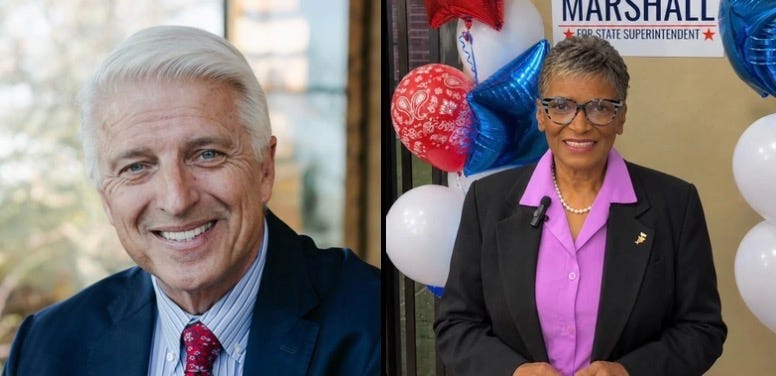
As Oklahomans prepare to vote on November 3, one question deserves attention: Could staying home or leaving the State Superintendent race blank affect the outcome?
Some voters may be unhappy with their choices. They might stay home entirely, vote in other races while leaving the superintendent section of their ballot blank, or cross party lines to vote for a candidate they believe better represents their views.
Social media comments suggest that some Republicans are considering leaving this race blank because they are dissatisfied with the candidates. While those comments do not represent a verified statewide trend, they raise questions about voter dissatisfaction, party divisions and whether political fatigue could influence the election.
Why Are Some Republicans Hesitant About Dr. Robert Franklin?
Several issues have prompted questions and debate among some conservative voters about Republican State Superintendent candidate Dr. Robert Franklin.
1. His Previous Democratic Party Registration
Franklin was registered as a Democrat before changing his party affiliation to Republican in 2023. He has said he changed parties because the Democratic Party had moved too far to the left.
However, public social media posts have raised additional questions about the circumstances surrounding that change. In a Facebook video, Franklin’s campaign consultant reportedly claimed that Franklin changed his party affiliation “to win.”
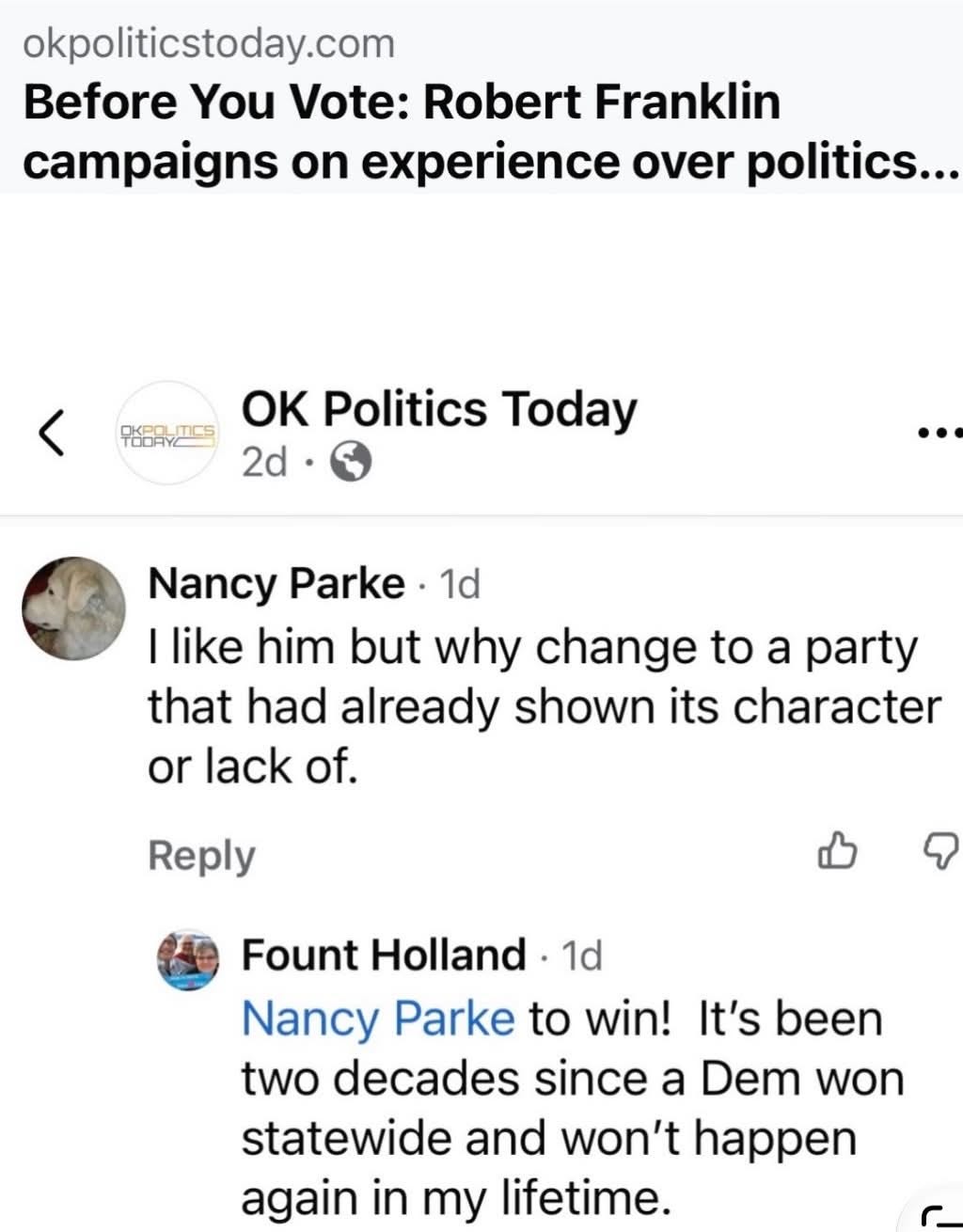
The consultant also reportedly stated in a separate Facebook post, “It’s been two decades since a Dem won statewide and won’t happen again in my lifetime.”
These comments take on added significance in the context of Oklahoma’s statewide election history. No Democrat has won a statewide election in Oklahoma since 2006, giving Republican candidates a substantial historical advantage in statewide races. Oklahoma State Election Board — General Election Results.
Taken together, the consultant’s reported remarks could reasonably be interpreted as suggesting that running as a Republican offered a more viable path to winning elected office in Oklahoma than running as a Democrat.
That raises an important question for voters:
Was Franklin’s party change motivated by a genuine shift in political beliefs, or was it because of the electoral advantages associated with Republican registration in Oklahoma?
Remember, Franklin did not qualify for the Oklahoma Republican Party’s Certified program, which included a requirement concerning registration with another political party during the preceding five years. The state party endorsed his Republican runoff opponent, Dr. James Taylor.
Some Republicans may view Franklin’s political history and the consultant’s reported remarks as reasons to examine his conservative credentials more closely. Others may argue that candidates should be judged primarily by their current policy positions, public statements and records. Either way, Robert Franklin does not appear to be a conservative option on the ballot.
Ultimately, voters deserve transparency about candidates’ political histories and the circumstances surrounding their party affiliations. For voters who expect Republican nominees to reflect conservative principles, both a candidate’s record and the public statements made by those involved in the campaign may be relevant.
2. His Position on St. Isidore Catholic Virtual Charter School
Franklin voted against approving St. Isidore of Seville Catholic Virtual Charter School, a publicly funded religious charter school. His position involved constitutional and legal concerns surrounding the proposal.
Some conservative Christians who support religious school choice disagreed with that position. Others may view legal and constitutional questions involving public funding and religious schools differently.
The disagreement illustrates that conservative voters can share broad political values while differing over how those values should be applied to specific education policies.
3. His Comments About Diversity, Equity and Inclusion
Franklin has described diversity, equity and inclusion, commonly referred to as DEI, as a biblical principle.
This comment comes despite the fact that DEI practices across the nation have resulted in discrimination against individuals and result in racist & discriminatory policies, often against white males & Christians.
Some Republican officials have compared Franklin to Texas politician James Talarico, who is known for discussing political issues through a Christian and religious framework.
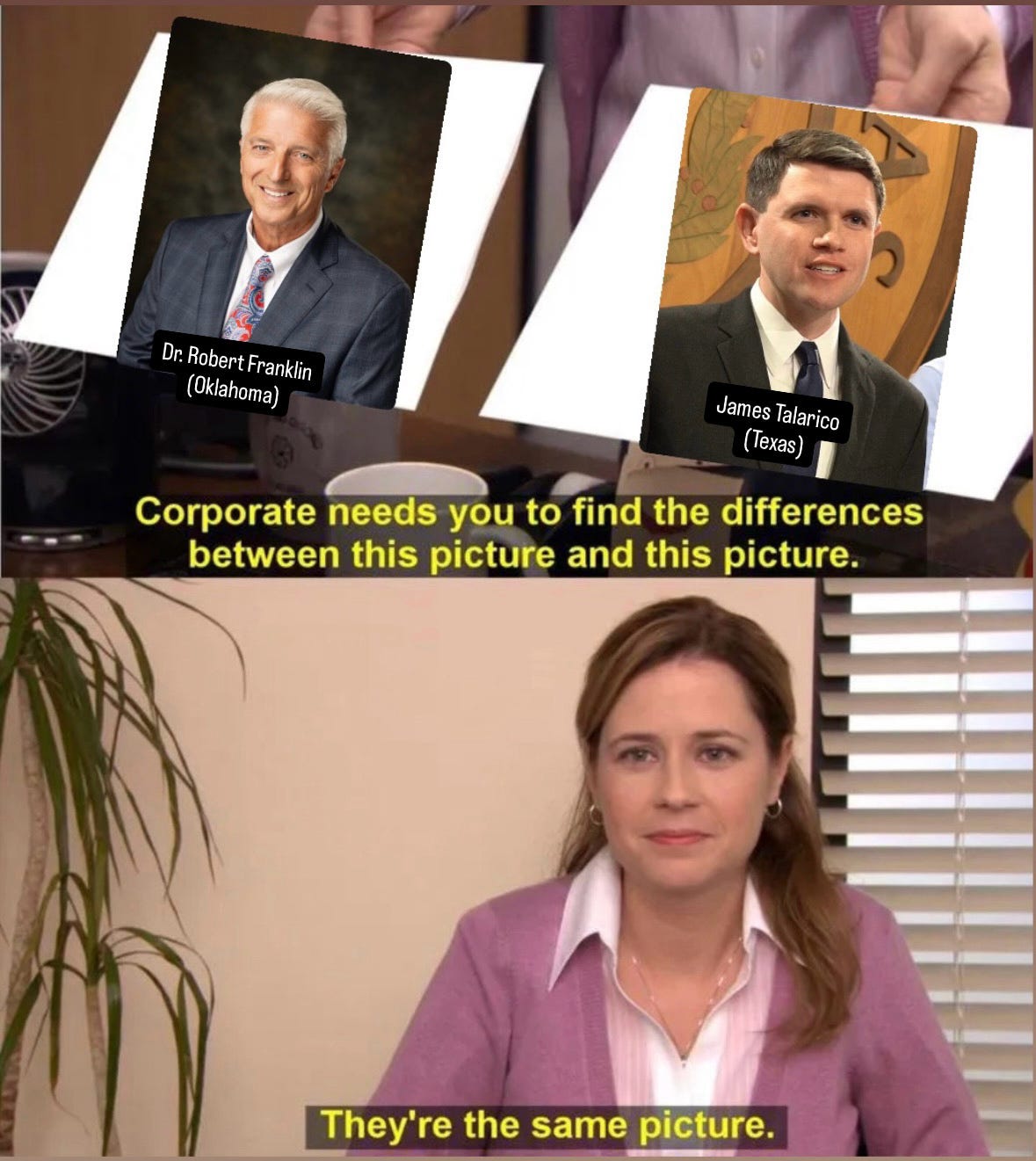
Franklin’s comments have become part of the broader debate about whether his positions align with the expectations of some conservative Republican voters.
4. Campaign Videos Filmed on School Property
Campaign videos filmed on public school property by Franklin and his Republican runoff opponent also drew scrutiny.
The matters were reportedly resolved after the videos were removed, following attention from the Oklahoma Ethics Commission. The episode raised questions about campaign conduct and the use of public school property for political purposes.
Voters may weigh such questions differently when evaluating candidates.
Was Dr. James Taylor the Conservative Choice?
Some conservative voters viewed Dr. James Taylor as the candidate who better represented their priorities in the Republican runoff.
During the campaign, comparisons between Taylor and former State Superintendent Ryan Walters—including the description of Taylor as “Ryan Walters 2.0”—became part of the political discussion.
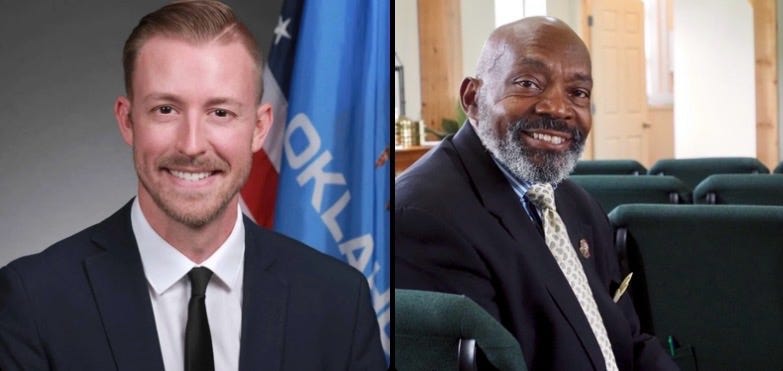
Some Taylor supporters believe the comparison was unfair and may have influenced how voters viewed him. They point to the fact that both men have spoken openly about their Christian faith. However, sharing a faith or speaking publicly about religion does not establish that two candidates would govern in the same way.
There is good reason to believe that this unfair comparison, portrayed by the liberal media and on social media by many, may have cost Taylor the Republican Primary.
Some conservatives also believe the broader debate over Franklin and Taylor reflects a larger concern about the direction of the Oklahoma Republican Party and whether candidates running under the Republican label consistently represent the party’s conservative voters.
Are Democrats Running as Republicans to Influence Oklahoma Elections?
Oklahoma Republicans need to ask a serious question: Are Democrats registering as Republicans to influence our primaries and push candidates who do not represent conservative values?
It is a question that deserves more than a shrug.
According to KOCO’s June 12, 2026, report, thousands of Oklahomans changed their party affiliation in the months leading up to the 2026 primary elections. Among them, 3,090 Democrats switched their registration to Republican, while 3,529 independent voters also registered as Republicans.
Those numbers raise an obvious question: Why are so many voters changing their party affiliation, and what does that mean for the future of the Oklahoma Republican Party?
Republicans should not ignore the possibility that some individuals may change parties to influence Republican primaries.
If a candidate runs as a Republican but supports policies that many conservative voters consider fundamentally opposed to Republican principles, voters have every right to ask whether the party label tells the whole story.
The concern becomes especially significant when voters believe they are choosing a conservative Republican, only to discover positions they believe conflict with their values. Party affiliation should mean something. Republican voters deserve transparency about candidates’ political histories, records and beliefs—not simply a familiar letter beside a name on the ballot.
Oklahoma Republicans should examine the facts and ask hard questions. Who changed parties? When did they change? What positions have they advocated? And do their records reflect the principles they claim to represent?
The future of the Republican Party should be decided by voters who understand what they are voting for—not by assumptions based on a party label.
If Oklahoma Republicans want to preserve the principles that brought them into the party, they must pay attention to who is seeking its nominations and what those candidates actually believe.
The question is not whether people have the right to change parties. They do. The question is whether Republican voters are paying enough attention to ensure that the candidates carrying their party’s name genuinely represent them.
What Does the Voter Registration Data Show?
KOCO’s June 12, 2026, report, “Thousands of Oklahoma Voters Change Party Affiliation Ahead of Primary Elections”, documented thousands of party-registration changes since January.
According to the figures reported from Oklahoma State Election Board data:
3,090 Democrats registered as Republicans.
1,330 Republicans registered as Democrats.
5,319 independent voters registered as Democrats.
3,529 independent voters registered as Republicans.
Approximately 3,500 voters left a political party to register as independents, including 1,945 Republicans and 1,564 Democrats.
Oklahoma Voice also reported on party-affiliation changes in its April 10, 2026, article, “Thousands of Oklahomans Switched Party Affiliation Ahead of Primary Elections.” That report noted that it was unclear whether the changes were higher than normal because the State Election Board could not provide a comparable report for the same period in 2022.
The numbers provide context for a broader question about party identity: Is the Republican label alone enough to establish that a candidate shares the policy priorities of conservative voters?
Some Republicans believe candidates should be judged individually by their records, public statements and proposals. Others worry that voters may overlook meaningful ideological differences because a candidate appears on the ballot as a Republican.
The debate is not simply about registration. It is about trust, representation and the direction of the party.
Why Are Some Republicans Considering Voting for Democrat Jennettie Marshall?
Another factor in the superintendent race is Democratic candidate Dr. Jennettie Marshall and her position concerning the Tulsa Public Schools audit.
The audit scrutinized the district’s finances, making fiscal accountability an important issue for some voters. Some Republicans who prioritize transparency and financial oversight may consider Marshall because of her position on the audit, even if they typically vote Republican.
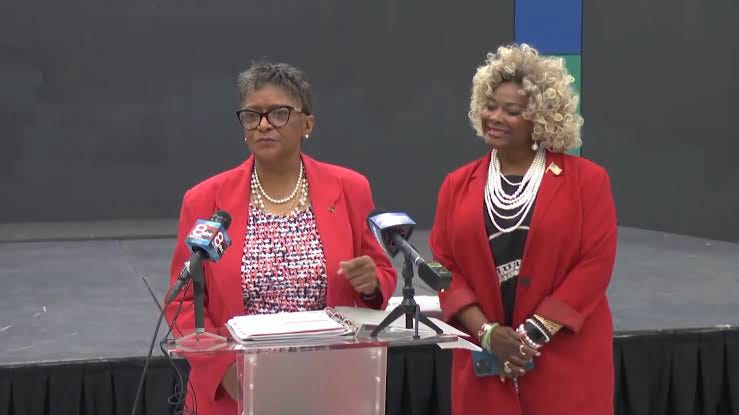
For some of these voters, the choice may feel like choosing “the lesser of two evils,” so to speak: They have reservations about Franklin but are also hesitant about voting for a Democrat.
Possible responses include voting for Marshall, voting for another candidate, leaving the superintendent race blank or not participating in the election at all.
There is no verified statewide count showing how many Republicans are considering any of these options. Social media comments alone cannot establish how widespread the sentiment is.
Could Political Fatigue Split the Republican Vote on November 3?
After years of intense campaigning, contentious elections and relentless political battles, another factor could influence Oklahoma’s November 3 election: political fatigue within the Republican voter base.
Over the past eight to twelve years, American politics has become a constant presence in the lives of many voters. Presidential campaigns, congressional elections, heated debates over national policy and ongoing partisan conflict have kept the country in a nearly continuous state of political mobilization.
For many conservative voters, this period has also brought significant victories and renewed engagement in the political process. But sustained political involvement can come with exhaustion, frustration and disagreements over the direction of the Republican Party.
This is not necessarily a rejection of President Donald Trump, the conservative movement or Republican principles. Rather, it reflects the possibility that Republican voters themselves are becoming more divided over candidates, priorities and the future direction of their party.
Some Republicans remain energized and eager to participate. Others are frustrated with particular candidates, disappointed by internal party disagreements or simply tired of the intensity of modern political campaigns. Still others may believe their preferred candidates have not adequately represented their conservative Christian values.
A divided Republican electorate does not necessarily mean voters have abandoned their principles. It may mean they disagree about who best represents those principles—or have grown weary of the political process itself.
That distinction matters as Oklahoma approaches November 3.
When Republican voters disagree over candidates, some may cross party lines, while others may leave individual races blank or stay home altogether. Even voters who remain firmly conservative may feel less motivated to participate if they are dissatisfied with the choices available to them.
The effects could extend beyond any single race. If some voters participate enthusiastically while others disengage, the election results will reflect both the choices of participating voters and the absence of those who decide not to vote.
Oklahoma’s State Superintendent race offers an example of how dissatisfaction within a party can generate difficult decisions for voters. Republicans who disagree about their nominee may respond in different ways, including supporting another candidate, skipping the contest or declining to participate in the election.
There is no verified statewide measurement establishing how many Oklahoma Republicans are experiencing political fatigue or how significantly it may affect turnout. Social media discussions can reveal concerns being expressed by some voters, but they cannot establish the views of the entire Republican electorate.
Nevertheless, political fatigue is worth considering alongside candidate positions, party affiliation and campaign strategy.
For conservative Christians, political participation is often connected to concerns about religious liberty, parental rights, education, family values and the future of their communities. Disagreement over candidates does not erase those concerns, nor does frustration necessarily mean a voter has abandoned the conservative movement.
The challenge is determining whether dissatisfaction will lead voters to seek change through the ballot box or withdraw from the process altogether.
On November 3, Oklahoma’s election will be shaped not only by the candidates voters support, but also by how voters respond to years of intense political campaigning and internal party disagreements.
The question is whether political fatigue will remain a source of frustration—or become a factor that changes who shows up to vote.
Could Voter Apathy and Political Exhaustion Affect the Outcome?
Political fatigue can have consequences beyond disagreements over individual candidates. It can also contribute to voter apathy—the feeling that participating in an election will not make a difference.
Some Americans have expressed exhaustion with the political process after years of intense campaigns, heated national debates and contentious federal elections. For some, the constant cycle of political conflict has left them frustrated, discouraged or less interested in participating.
For conservative Christians, that frustration may be especially pronounced when they believe foundational principles, traditional values and moral convictions are being challenged in the political arena. Some feel political leaders have abandoned principles they once promised to defend. Others are tired of campaigns dominated by personal attacks, political theater and partisan infighting rather than meaningful solutions.
That exhaustion could have consequences in Oklahoma on November 3.
Some voters may be dissatisfied with the candidates running for office. Others may feel disconnected from their own party, disappointed by the choices available to them or exhausted by years of political conflict. Rather than supporting a candidate they believe represents their values, they may stay home, leave individual races blank or disengage from politics altogether.
For conservative voters, this presents a dilemma. If Republicans believe their party has drifted from its founding principles, abandoning the ballot box may feel like a protest. But it also means surrendering an opportunity to influence the direction of their communities and state.
When voters become disillusioned, they do not always switch parties or publicly announce their dissatisfaction. Sometimes, they simply stop participating.
In a closely contested race, even a relatively small change in turnout can affect the distribution of votes. If voters who are dissatisfied with their choices decide not to participate, their absence may matter just as much as the decisions of those who do show up.
Elections are decided by the people who cast ballots—not by the people who merely express frustration about politics.
For Christians, civic participation can also be understood as a responsibility to one’s neighbors and community. Scripture calls believers to pursue justice, exercise discernment and act with integrity. While Christians may disagree about candidates and policies, withdrawing from civic life is not the only response to disappointment.
Voters do not have to approve of every candidate to recognize that their participation matters. Conservatives who care about parental rights, religious liberty, educational accountability, limited government and the future of Oklahoma should consider how their decisions—or their decision not to participate—may affect those priorities.
Political exhaustion is understandable. But for Oklahomans who believe their values, families and communities are worth defending, disengagement carries its own consequences.
What Authority Does the State Superintendent Have?
Oklahoma’s State Superintendent of Public Instruction is an elected statewide official, but the office does not have unlimited authority over public education.
The State Board of Education also plays an important role in education policy. The governor appoints the other six members of the board, subject to confirmation by the Oklahoma Senate.
The superintendent and the board operate within authority established by state law. The Legislature can consider changes to education statutes and review proposed administrative rules through the applicable rulemaking process.
That means Oklahomans do not have to wait until the next superintendent election to participate in debates about education policy. Citizens can contact their state representatives and senators, attend public meetings, participate in legislative processes and hold elected officials accountable between elections.
Sitting Out Impacts Election Results
History provides examples of how voter participation can affect election outcomes. In Georgia’s 2024 Republican primary runoff for the 3rd Congressional District, Brian Jack defeated Mike Dugan by 11,961 votes, while 23,067 fewer people voted in the runoff than in the initial primary. According to FairVote, the number of voters who did not return to the polls was large enough to have potentially changed the result had they participated and voted differently. Although we cannot know how those absent voters would have voted, the example demonstrates how lower turnout can influence which candidate wins.
A 2017 Pew Research Center analysis of the 2016 presidential election found that 25% of registered voters who did not vote cited dislike of the candidates or campaign issues as their primary reason for staying home. Approximately 4.7 million registered nonvoters gave that reason. These findings illustrate how dissatisfaction can lead people to withdraw from an election rather than participate. In Oklahoma’s November 3 election, voters who skip the superintendent’s race or sit out the election entirely should understand that their absence does not stop the election from being decided. When voters who might otherwise support a candidate do not participate, the remaining votes determine the outcome—and that can benefit a candidate those absent voters would not have chosen.
What Do We Know?
As of October 26, social media comments indicate that many Republican voters are discussing skipping the State Superintendent race.
KOCO’s reporting documents thousands of party-affiliation changes in Oklahoma during 2026. Those figures provide relevant context for discussions about party identity, but they do not prove that party changes were coordinated or that the people who switched parties hold any particular position on the superintendent candidates.
The reported remarks from Franklin’s campaign consultant add another dimension to the debate. The comments could be interpreted as suggesting that the electoral advantages of Republican registration in Oklahoma factored into the discussion of Franklin’s party change.
Political fatigue may also be a factor. After years of intense campaign seasons and divisive federal elections, some voters may be less motivated to participate, while others remain energized. Whether that division will materially affect Oklahoma’s November 3 results remains uncertain.
Ultimately, the question is whether dissatisfaction with the candidates and the political process will lead some voters to stay home, skip the superintendent contest or vote across party lines.
Oklahomans will make their choices on November 3. Understanding the candidates’ records, the limits of their authority and the available evidence can help voters make informed decisions across the entire ballot.
We know that past elections where Republican voters have chosen to sit out negatively impacted election results for Republicans.
The future of Oklahoma’s education system and the direction of its political parties will not be determined by social media arguments alone. They will also be shaped by the choices voters make—and by who chooses to participate.
If Republicans sit this one out, Democrats gain another victory in Oklahoma.

This is an editorial article based on a combination of opinions, research, and personal experiences.
Like & Follow The Oklahoma Lion Media On Facebook and Twitter / X
If Oklahoma permitted write in on ballots I would put Dr. James Taylor.
Interesting to read your analysis and to also read Jason Murphey’s!