


Across Oklahoma, cameras capable of automatically reading and recording license plates are becoming an increasingly common part of the law-enforcement landscape.
The technology is generally known as automated license plate recognition (ALPR). Flock Safety is one company that provides this technology, but it is not the only vendor operating in Oklahoma.
Law-enforcement agencies say these systems can help locate stolen vehicles, missing persons and criminal suspects. At the same time, the rapid expansion of the technology has raised questions about how much information is collected, how long it is retained, who can access it and whether information gathered for one purpose can eventually be used for another.
Those questions are no longer theoretical. Oklahoma communities are now having those debates firsthand.
What is happening in Oklahoma?
Tulsa Police Department’s Flock Safety information page says the Tulsa Police Department began using Flock Safety license-plate-reader technology in the summer of 2022.
TPD says the technology is intended to help solve crimes and improve public safety. Its written ALPR policy states that the system can be used to detect violations of law, recover stolen property, apprehend fugitives and investigate crimes. The policy also says access to ALPR data is limited to authorized users for law-enforcement investigative purposes. Tulsa Police Department ALPR Policy 113C
Tulsa is not alone.
In 2023, the Broken Arrow City Council approved a one-year, $18,250 agreement with Flock Safety for five license-plate-reader cameras. The agreement included a 60-day pilot period during which the city could terminate the contract without penalty. Broken Arrow City Council record
Importantly, that 2023 agreement does not establish that those original five Flock cameras are still operating today.
But Broken Arrow has continued expanding its license-plate-recognition infrastructure.
In May 2025, the city approved $271,209 for cameras from Orion Security Solutions covering 30 major intersections. The city said the cameras would benefit both the Broken Arrow Police Department and the Streets Department, with funding coming from the Public Safety Sales Tax Fund and the Streets Department’s Sales Tax Capital Improvement Fund. City of Broken Arrow — May 20, 2025 Council recap
Then, in May 2026, Broken Arrow approved another $82,576.12 for Hanwha 4K license-plate-reader cameras from Orion Security Solutions. The city said those cameras would be installed at 30 major intersections to help its Real Time Information Center locate stolen vehicles, missing persons and suspects involved in serious crimes. City of Broken Arrow — May 5, 2026 Council recap
The Broken Arrow example illustrates an important distinction: ALPR technology is broader than Flock Safety itself. A community may stop using Flock while continuing to operate license-plate-reading cameras supplied by another company.
Oklahoma City recently renewed its Flock contract
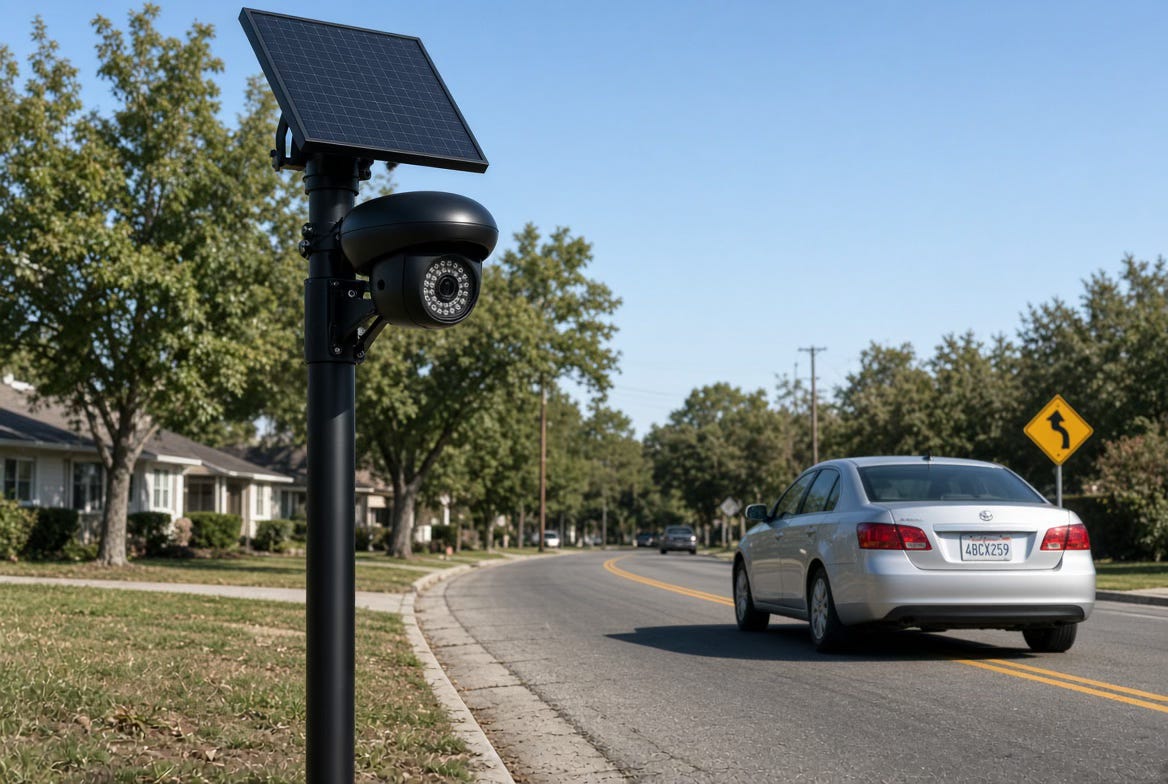
Oklahoma City provides another example of the debate.
On August 18, 2026, the Oklahoma City Council voted 5-3 to renew its Flock Safety contract. The renewed agreement costs $270,000 and covers 90 cameras through June 30, 2027. Oklahoma Gazette’s report on the renewal
The renewal also included changes to the city’s use of the system.
According to reporting on the council’s decision, Oklahoma City Police Chief Ron Bacy said the department would opt out of Flock’s national database and use a seven-day retention setting rather than the previous 30-day period, except when longer retention is necessary for evidentiary purposes. KOCO’s report on the OKC contract renewal
The Oklahoma City debate demonstrates why the details of a surveillance-camera contract matter. Two cities can use the same technology while having different rules concerning retention, sharing and access.
Some Oklahoma communities are going in the opposite direction
Not every Oklahoma community has chosen to expand or renew Flock.
In August, Coweta Police Chief Mike Bell asked Flock Safety to remove the city’s two cameras and announced that Coweta would not renew its contract for the 2027 budget year. Bell cited ongoing citizen concerns regarding Fourth Amendment rights. KRMG’s report on Coweta’s decision
Bell said the cameras had helped the department catch shoplifters, but he wanted the cameras removed so the community could have a broader conversation about the technology. Tulsa Flyer’s report on Coweta’s decision
Marietta went even further.
In August 2026, the Marietta City Council voted to cancel its Flock contract after residents raised concerns about surveillance and data retention. The city had installed five temporary Flock cameras roughly three months earlier. During the meeting, Police Chief Brett Harris said he learned that Flock retained data beyond the 30-day period the department understood would apply, and he told the council that was not something the department would support. KXII’s report on Marietta’s decision
And on September 2, 2026, Thackerville Police announced that it was ending its Flock Safety contract. Chief Jonathan Buckaloo cited the importance of the department’s relationship with residents as part of the decision. KXII’s report on Thackerville ending its Flock contract
The Oklahoma debate therefore is not simply about whether police use cameras. It is increasingly about what rules govern those cameras once they are deployed.
Why are some citizens concerned?
ALPR cameras generally capture information that is visible from public roads, including a vehicle’s license plate and information associated with the vehicle’s location and time of detection.
Tulsa’s own policy says ALPR technology collects information individuals have made visible to the public and limits access to authorized users for law-enforcement investigative purposes. Tulsa Police Department ALPR Policy 113C
The concern raised by privacy advocates and some residents is what happens when thousands or millions of individual observations are accumulated over time.
A single camera may simply record a license plate passing an intersection. A sufficiently large network, however, can potentially create records showing where particular vehicles were observed at particular times.
That has prompted debates over data retention, access, sharing between agencies, searches without a warrant, mission creep and potential misuse by individual officers.
These concerns are not merely hypothetical.
Confirmed cases of misuse
In September 2026, an Albany County, New York, sheriff’s investigator was arrested after authorities said an internal investigation uncovered more than 4,000 unauthorized searches of Flock data, including approximately 3,000 searches involving her former girlfriend’s vehicle. The investigator was charged with official misconduct and falsifying business records. The sheriff’s office subsequently restricted access and ordered regular audits. Times Union report on the Albany County case
The important distinction is that these are criminal allegations against an individual officer, not a finding that Flock itself authorized the conduct. The case demonstrates, however, why access controls and audits matter when officers have access to large databases containing location information.
A separate case occurred in San Jose, California.
Police officials said an officer used his personal device to conduct unauthorized Flock searches involving a domestic-violence victim and then shared the victim’s location with the alleged suspect, who was a relative of the officer. The officer was subsequently fired, according to the San Jose police chief. CBS San Francisco’s report on the San Jose case
There are also documented cases involving ALPR technology more broadly.
In Pennsylvania, a police officer pleaded guilty to stalking and official oppression after using automated license-plate-reader information to monitor his estranged wife. Reporting on the case says her vehicle was scanned 283 times and her mother’s vehicle was scanned 85 times. People’s report on the Pennsylvania case
These cases do not establish that most officers misuse ALPR systems. They do establish that unauthorized access and personal misuse are real risks that have occurred.
Other states are putting rules around ALPR technology

Oklahoma is also not the only state wrestling with these questions.
Arkansas enacted Act 668 in 2025, which regulates the use of automatic license plate readers. Among other provisions, the law restricts how captured plate data can be used and generally limits retention to 60 days for private entities and 150 days for other eligible entities. Arkansas Legislature — Act 668 / SB446
Virginia enacted legislation addressing ALPR systems that includes requirements concerning law-enforcement policies, reports and protections surrounding the technology. The Virginia State Crime Commission lists HB 2724 among its 2025 legislation concerning automatic license plate recognition. Virginia State Crime Commission — 2025 legislation
Washington enacted a statewide ALPR law in 2026. The law expressly addresses driver privacy and automated license-plate-reader systems and establishes a statutory framework governing the use of ALPR data. The legislation states that its purpose includes balancing public safety with privacy protections and establishing guardrails around surveillance data concerning people’s location and travel. Washington State Legislature — Chapter 239 / SB 6002
Arkansas, Virginia and Washington illustrate that states are taking different approaches to the same underlying question: What rules should govern automated license-plate data after it has been collected?
What should Oklahomans be asking?
The debate over ALPR technology does not have to be reduced to “pro-police” versus “anti-police.”
The technology can provide investigators with useful information. At the same time, government agencies are entrusted with information capable of revealing patterns of where vehicles have been and when they were there.
That makes the rules surrounding the technology important.
Questions for Oklahoma communities include:
How many cameras are operating?
Who owns the cameras and the data?
How long is information retained?
Who can search the database?
Are searches logged and routinely audited?
Can one Oklahoma agency search another agency’s data?
Can information be shared with federal agencies or agencies outside Oklahoma?
What constitutes a legitimate search?
What happens when an employee conducts an unauthorized search?
Can residents find out where the cameras are located?
What happens to previously collected data if a city cancels its contract?
These are not abstract questions. Oklahoma cities are already answering them differently.
As of 2026, Broken Arrow has reported that the only camera uses today are owned by private companies and businesses within the city. Oklahoma City has renewed its Flock contract with new restrictions while Tulsa continues to use Flock technology under its ALPR policy. Meanwhile, Coweta, Marietta and Thackerville have all moved toward ending their Flock relationships in 2026. Oklahoma City contract report Tulsa Police Flock information Coweta decision Marietta decisionThackerville decision
The technology is here. The question facing Oklahoma communities is how transparent, limited and accountable its use should be — and what safeguards should exist before more information about people’s movements is collected and retained.
For Oklahomans, understanding exactly what cameras are operating in their communities, who controls the information and what rules govern its use is becoming increasingly important.

This is an editorial article based on a combination of opinions, research, and personal experiences.
Like & Follow The Oklahoma Lion Media On Facebook and Twitter / X